


Adaptive Game Soundtracks That Elevate Gameplay Examples of Success.
A great game soundtrack does more than sit under the action. It listens.
When a player sneaks through a guarded hallway, misses a jump, enters a boss arena, or rides across an open plain at sunset, the best music systems react without calling attention to themselves. The score stretches, thins out, swells, cuts away, or changes direction in ways that feel natural. Done well, the player may not notice the system at all. They only feel more focused, more tense, or more connected to the world.
That is the power of adaptive game music. It turns a soundtrack from a fixed recording into a living part of play. The examples below show how successful games use adaptive soundtracks to support combat, exploration, stealth, story, and atmosphere.

Adaptive music works because games do not move in straight lines
Film music can follow a locked timeline. Game music cannot. A player might spend three seconds in a room or 20 minutes. They might avoid combat, rush into it, pause halfway through, or trigger a story moment while standing in the wrong place.
Adaptive soundtracks solve that problem through systems. Instead of one complete track playing from start to finish, the score may use:
Vertical layering
Different instrumental stems fade in or out depending on intensity. A calm ambient bed might gain percussion, bass, or brass as danger grows.
Horizontal resequencing
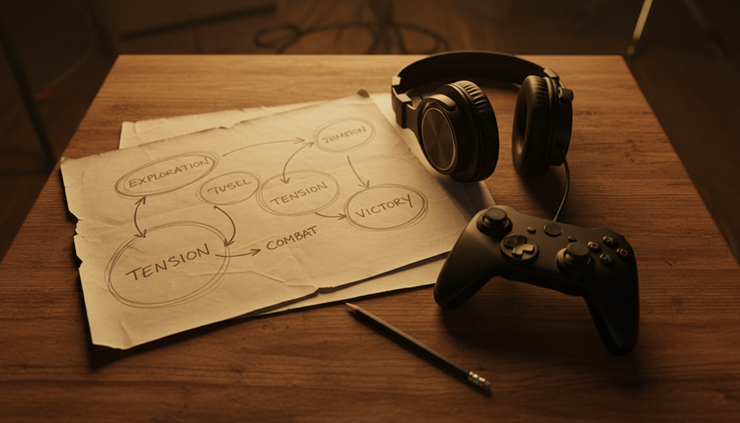
The music jumps between related sections, such as exploration, alert, combat, and victory, while staying in time and key.
Stingers and one-shot cues
Short musical accents highlight discoveries, enemy attacks, completed objectives, or sudden threats.
Parameter-based mixing
The game changes reverb, filters, volume, or instrumentation based on location, health, tension, or player choices.
The goal is not to show off complexity. The goal is to make the score feel locked to the player’s experience. The strongest adaptive soundtracks use technique in service of emotion.
Early successes proved that interactive scoring could feel musical
Adaptive music did not start with modern open worlds. Some of its most important ideas appeared decades ago, when game audio faced strict memory and hardware limits.
The Secret of Monkey Island and Monkey Island 2 smoothed out musical transitions
LucasArts’ iMUSE system, closely associated with composers Michael Land and Peter McConnell, remains one of the key milestones in interactive music. In games such as Monkey Island 2: LeChuck’s Revenge, music could shift between locations and moods without the awkward hard cuts common in older games.
That mattered because the comedy, pacing, and world-building depended on a light touch. The score could follow the player from one area to another while preserving tempo, musical key, and character. It felt less like a stack of separate tracks and more like a band responding to the scene.
The lesson still holds: transitions are part of the composition. If the join between two states feels clumsy, the illusion breaks.
The Legend of Zelda series uses musical restraint as a design tool
Nintendo has used adaptive music in many The Legend of Zelda games, but Breath of the Wild is a standout because of how much it leaves out. Rather than filling every moment with continuous melody, the game often uses sparse piano notes, soft textures, and environmental sound.
That restraint gives the world room to breathe. A quiet ride across Hyrule feels lonely and open. Combat cues can enter with more impact because the baseline is so spacious. Discovery stingers and location themes stand out without overwhelming the player.
Breath of the Wild shows that adaptive music does not always mean more layers. Sometimes the smartest system knows when to step aside.

Combat games succeed when the music tracks intensity moment by moment
Combat is one of the clearest uses for adaptive scoring. The player feels the change right away. If the score rises too soon, it feels fake. If it lags behind, it feels weak. The best combat systems match musical energy to the actual state of play.
Doom turns aggression into a feedback loop
Doom from 2016 and Doom Eternal use heavy, layered music to support fast, forward-moving combat. Mick Gordon’s score became known for its metallic textures, distorted guitars, synthetic weight, and rhythmic drive. What makes it especially effective in play is how the music responds to intensity.
As encounters build, musical layers grow heavier. When the fight peaks, the score feels massive. When the arena clears, the pressure releases. The music reinforces the game’s central idea: keep moving, keep attacking, keep pressing forward.
The soundtrack does not merely accompany violence. It teaches the rhythm of the game. The player hears escalation and responds with aggression.
Hades makes repetition feel alive
Supergiant Games’ Hades, with music by Darren Korb, faces a design challenge shared by many roguelikes. Players repeat rooms, fights, and routes often. A static soundtrack would quickly become tiring.
The solution is variety through context. The music shifts between underworld regions, conversations, combat states, boss fights, and narrative moments. Rock instrumentation, Mediterranean colors, vocal songs, and tense battle cues all fit within a clear musical identity.
The adaptive work is not always flashy. A fight may add energy at the right moment. A boss theme may bring in a stronger performance layer. A quiet area may give the player a short emotional reset. Those shifts help repeated runs feel less mechanical and more like a story still unfolding.
Left 4 Dead uses music as a warning system
Valve’s Left 4 Dead is a strong example of music tied to threat awareness. The game’s AI Director changes pacing, enemy pressure, and tension. The audio supports that design with cues that warn players about special infected, rising danger, or a coming horde.
These musical cues do useful work. They give players information without filling the screen with more UI. A short motif can tell the group that a specific threat is near. A tension cue can prepare players before chaos hits.
That is adaptive scoring at its most practical. It improves play because it helps players read the world.
Exploration and story benefit from music that follows place and emotion
Not every adaptive score is about danger. Some of the best examples support travel, memory, identity, or narrative change. These systems often work more subtly, shaping how a place feels over time.
Red Dead Redemption makes travel feel cinematic without forcing it
Rockstar’s Red Dead Redemption games use interactive music to give open-world travel and mission sequences a strong sense of tone. While riding, exploring, or entering a mission, instrumental layers can enter and leave in a way that follows motion and context.
This works because the music respects player freedom. It does not pretend every ride is equally dramatic. A quiet journey can stay open and atmospheric. A mission can gather tension. A major narrative beat can feel more directed without turning the game into a cutscene.
The player remains in control, but the score gives the moment shape.
NieR Automata shifts identity through arrangement and vocals
Nier: Automata, composed by Keiichi Okabe and collaborators, is a standout for how it changes musical texture across gameplay states and story contexts. Themes can appear in different arrangements depending on whether the player is exploring, fighting, hacking, or facing major story events.
The use of vocals, including invented language, gives the score a haunting quality that can feel human and distant at the same time. When the game changes the arrangement around a familiar theme, the emotional meaning changes with it.
That adaptability supports the game’s structure. Repeated spaces do not always feel the same because the music reframes them.

Hitman uses music to manage stealth tension
The modern Hitman games need music that can handle social stealth, exploration, suspicion, open combat, and escape. The player may spend long stretches observing routines, then cause a sudden chain reaction.
The score responds by staying out of the way during careful planning, then adding pressure when guards grow suspicious or combat breaks out. Smooth musical state changes help preserve the fantasy of being inside a living location.
A loud or overactive score would work against the game’s design. The music succeeds because it understands the player’s need to listen, watch, and plan.
Celeste uses musical layers to support challenge and emotion
Celeste, with music by Lena Raine, uses its score to support both precision platforming and emotional storytelling. Tracks often build across a chapter, adding parts as the challenge grows or as the narrative pressure rises.
This approach helps hard sections feel purposeful rather than punishing. The music can energize repeated attempts without becoming too harsh. Softer passages create space for vulnerability and reflection.
For a game about climbing, failure, anxiety, and persistence, that musical arc matters. The score adapts not only to action, but to the player’s emotional journey.
The best adaptive soundtracks share a few design choices
The games above sound very different, but their music systems tend to succeed for similar reasons.
Game | Adaptive approach | Why it works |
Monkey Island 2 | Smooth musical transitions between areas | Keeps comedy and pacing intact |
Breath of the Wild | Sparse cues and selective musical entries | Makes silence and discovery meaningful |
Doom | Intensity layers tied to combat | Pushes the player toward aggressive play |
Hades | Contextual combat, area, and story music | Keeps repeated runs fresh |
Left 4 Dead | Threat cues linked to enemy and horde behavior | Gives useful information through sound |
Nier: Automata | Changing arrangements and vocal textures | Reframes familiar spaces emotionally |
Hitman | Stealth, suspicion, and combat states | Supports planning without distraction |
Celeste | Layered progression across challenge and story | Connects difficulty with emotional momentum |
A few patterns stand out.
The music has a clear purpose. It may guide combat behavior, mark danger, support a mood, or make a location feel alive. It does not react just because it can.
The system protects musicality. Good adaptive scores avoid random-feeling cuts. They use timing, key, tempo, stems, or transitional cues so changes feel composed.
Silence has value. Many memorable adaptive scores make room for ambient sound, player thought, and contrast.
The player never feels punished by the soundtrack. If a difficult section repeats often, the music needs enough variation or restraint to survive repetition.
What these examples teach about successful adaptive music
Adaptive scoring works best when composers, audio directors, and designers plan together. A beautiful track can fail if it does not fit the game’s timing. A clever system can fail if the music lacks identity. The strongest results come from treating music as part of the game design rather than decoration.
For teams building adaptive music, these examples point to a few practical rules:
Write for states and transitions, not only for full tracks.
Decide what the music should tell the player before adding layers.
Give repeated gameplay enough variation to avoid fatigue.
Let the game’s genre shape the system. Stealth, horror, combat, and exploration need different musical behavior.
Test with real play, because players rarely move at the speed a composer expects.
The most successful adaptive game soundtracks do not draw a bright line between music and gameplay. They make every fight, ride, escape, and discovery feel more responsive. When the system disappears and the moment feels right, the soundtrack has done its job.


Comments