


Film Music Mixing Tips for Creating Depth Space and Power in a Cinematic Score
A cinematic score can have beautiful themes, expensive samples, and a huge orchestral palette, yet still feel flat. The mix decides whether the music wraps around the scene or sits on top of it. It decides whether the low brass feels massive, whether the strings breathe, and whether the audience can feel distance, danger, grief, or release.
Film music mixing is less about making every track sound impressive on its own. It is about building a believable world where instruments have size, placement, and emotional weight. Depth, space, and power come from choices that support the story, not from turning everything up.

Start with the arrangement before touching the mix
The fastest way to create a powerful score is to avoid overcrowding it. A mix cannot fully fix an arrangement where every section plays in the same register at the same intensity.
Before EQ, compression, or reverb, listen to the cue as a piece of storytelling. Ask what the scene needs at each moment.
Which instrument carries the emotional idea?
Which section provides weight?
Which parts add motion?
Which parts only fill space because they were easy to add?
If the answer is unclear, mute tracks until the cue speaks again. Many cinematic mixes get bigger when a few layers disappear.
Register control matters most. Low strings, low brass, taikos, synth bass, and sub hits can all fight for the same space. If they all hit at once, the cue may feel loud but not powerful. Let one element own the bottom end at a time. For example, if the contrabasses and low brass state the theme, let the drums support the pulse higher up or keep them shorter and tighter.
The same applies to the high end. Violins, flutes, cymbal rolls, risers, and airy synths can create emotion, but too much top-end motion makes a mix feel nervous and thin. Pick the brightest element for the moment and let the rest play a supporting role.
Think in layers:
Layer | Main job | Mixing goal |
Melody | Carries the story | Clear, present, emotionally direct |
Harmony | Adds color and movement | Wide enough to support, not so wide it distracts |
Rhythm | Drives pace and tension | Tight, controlled, synced to picture |
Low end | Creates weight | Focused and clean |
Texture | Adds atmosphere | Felt more than noticed |
A great score mix often begins with a simple decision: what should the audience feel first? Once that is clear, the technical choices get easier.
Build depth with volume, tone, and early reflections
Depth is the front-to-back image of a mix. It tells the listener what feels close, what feels mid-distance, and what feels far away. Reverb helps, but depth does not come from reverb alone.
To push an instrument forward, make it clearer and more direct. Use less reverb, a little more midrange presence, and a touch more level. To push an instrument back, reduce brightness, soften transients, lower the direct level, and give it more room sound.
A simple depth map can help:
Front Solo cello, lead violin, piano motif, featured vocal, or a close synth pulse
Middle Main string body, horns, woodwinds, hybrid percussion, supporting ostinatos
Back Choir pads, distant brass swells, cymbal rolls, long textures, room tails
Early reflections are especially useful. They tell the brain the size of the room before the long reverb tail appears. A short room or stage reverb with clear early reflections can make instruments feel placed on a scoring stage rather than pasted onto the mix.
Use pre-delay with intent. A longer pre-delay can keep a featured melody close while still giving it a grand space. A shorter pre-delay can make an element blend into the room.
A useful starting point:
Lead instrument More direct sound, modest reverb, clear pre-delay
Section body Shared room, moderate reflections, less individual detail
Distant texture Darker tone, longer tail, lower direct level
Depth also depends on EQ. Distant sounds usually have less top-end detail and less low-mid punch. Rolling off some highs can place an instrument farther back without adding more reverb. Be careful with broad cuts, though. If every background layer gets dark, the score can turn muddy.
The goal is a believable stage. The listener should not think about the mix. They should simply feel that the music has a front, a center, and a horizon.
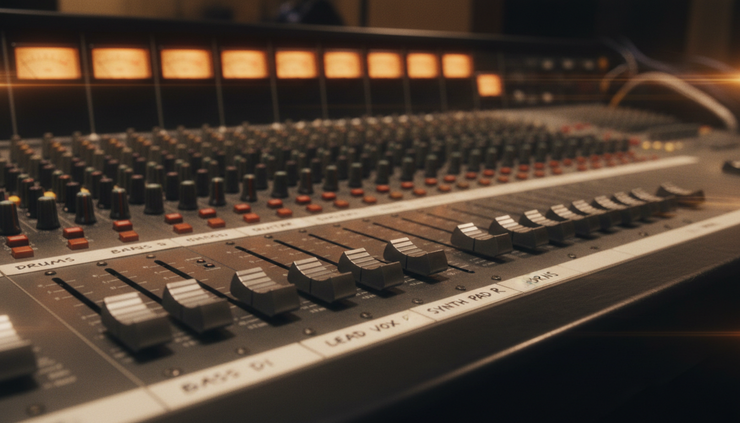
Create space without washing out the score
Space gives a cinematic cue scale. It can make a string line feel intimate or make a brass chord feel like it belongs in a huge hall. The mistake is treating reverb as a single blanket over the entire session.
A score usually works better with a few related spaces instead of one giant reverb on everything. For instance, you might use:
A short room for close instruments and percussion
A medium scoring stage for orchestral sections
A longer hall for emotional swells and big transitions
A separate effect reverb for supernatural or dreamlike moments
These spaces should feel related. If one section sounds like it lives in a dry studio and another sounds like it lives in a cathedral, the cue can feel disconnected unless the contrast serves the scene.
Send levels matter. A common problem in film music mixing is sending too many elements to the long reverb. The tail builds up, the rhythm loses focus, and the dialogue range gets crowded. Long reverbs create emotion, but they also use space quickly.
Try this approach:
Start with the dry balance.
Add a short shared room until the cue feels connected.
Add a medium stage reverb for size.
Add a long reverb only to moments that need emotional lift.
EQ the reverb returns so they do not cloud the main mix.
Reverb EQ can save a cue. High-pass the return to reduce low-end buildup. Tame harsh upper mids if the tail feels metallic. Roll off some top end if the space feels too shiny. A darker reverb often feels more cinematic because it supports the source instead of calling attention to itself.
Panning also shapes space. Orchestral panning often follows a stage layout, with first violins to one side, cellos and basses to the other, brass and percussion farther back, and woodwinds near the center. Hybrid scores can bend that layout, but the mix still needs logic. If a huge drum, a bass synth, and low brass all sit wide, the center loses impact.
Keep low-end energy mostly centered. Wide low frequencies can feel impressive in headphones but unstable on larger systems. Let width live in the mids, highs, room reflections, and harmonic layers.
Space should support focus. If the audience cannot tell what matters, the mix is too wide, too wet, or too crowded.
Make the score powerful without making it harsh
Power does not come from maximum level. It comes from contrast, clean low end, controlled transients, and a strong center.
A cue that stays huge from start to finish eventually feels small. The ear adapts. Save full power for the moments that need it. Let the verse of the scene, the quiet reveal, or the low suspense pulse stay restrained so the hit, swell, or theme entry can feel earned.
Low end needs discipline. In cinematic music, the 40 to 120 Hz area can carry enormous force, but it can also blur quickly. Sub booms, bass drums, low synths, contrabasses, and trombones all compete there. Choose the role of each element.
For example:
Let the sub hit provide impact, then get out of the way.
Let basses sustain weight, but reduce unnecessary sub information.
Let low brass create aggression in the low mids instead of fighting the deepest bass.
Let percussion punch through with transient shape rather than more low-end level.
Sidechain compression can help, but use it lightly. If a bass drum triggers a small dip in a bass drone, the impact becomes clearer. If the dip is too obvious, the score starts to pump in a way that can distract from the picture.
Compression has a place, yet orchestral music often needs its natural dynamics. Heavy compression across strings or full orchestra can flatten the emotion. Use compression to solve a problem, not to imitate loudness.
Good uses include:
Catching peaks on aggressive percussion
Controlling uneven solo instruments
Adding density to synth layers
Gluing hybrid rhythm groups
Keeping low brass from jumping out too suddenly
Parallel compression can add weight while keeping transients alive. Blend a compressed percussion bus underneath the dry bus. Add just enough that the drums feel denser, then back it off slightly.
Saturation can also add power. A little harmonic color on brass, drums, synth bass, or the full music bus can make the cue feel louder without simply raising the fader. Keep it subtle. Too much saturation shrinks the depth and turns the high end brittle.

Mix around dialogue and sound design
A film score rarely lives alone. It shares space with dialogue, footsteps, explosions, ambience, Foley, and sound design. A cue that sounds huge in solo may fail under the scene.
The most sensitive area is often the midrange. Dialogue lives mainly in the mids, and many score elements compete there: violas, horns, woodwinds, piano, guitars, synths, and choir. If the music masks speech, the mix will need changes.
Do not wait until the final print mix to think about this. Build cue balances with the scene in mind. If possible, monitor against a temp dialogue and sound effects track. Even a rough reference helps.
Some practical moves:
Lower busy midrange patterns under dialogue.
Move rhythmic energy into higher or lower registers when speech matters.
Use automation instead of static levels.
Thin out pads during important lines.
Keep hard attacks away from key words unless they support the edit.
Automation is the core tool here. Film music breathes with picture. A theme may rise into a cut, duck under a line, then open again for a reaction shot. Static mixing misses those emotional shifts.
Use volume automation before reaching for complex processing. A half dB move can change the scene. Small rides often sound more natural than heavy compression.
Also watch the relationship between score hits and sound design hits. If a trailer-style boom lands at the same time as an explosion, the combined low end may distort or feel undefined. Sometimes the score should leave the hit to sound design and swell afterward. Other times the music should lead the impact. Decide which element owns the moment.
This is where stems help. Delivering organized stems gives the final mix team control without destroying the cue. Common stem groups include strings, brass, woodwinds, choir, percussion, synths, pulses, solo instruments, and effects. Print reverbs with care, and keep alternate versions if the production needs flexibility.
A cinematic score does not need to win every second. It needs to serve the scene.
Check translation before calling the mix finished
A mix can sound beautiful in one room and fall apart elsewhere. Translation matters because film music may be heard in theaters, living rooms, laptops, headphones, and mobile devices.
Check the cue at different volumes. Low-level listening reveals balance problems. If the melody disappears when the volume is quiet, it may not be present enough. Loud playback reveals harshness, low-end overload, and reverb buildup.
Use multiple references:
Studio monitors for balance and depth
Headphones for detail, edits, and stereo width
Small speakers for melody and midrange clarity
A mono check for phase issues
A low-volume pass for emotional focus
Mono may seem less exciting, but it catches problems fast. If wide strings, synths, or reverbs vanish in mono, the mix relies too much on phase tricks. Width should enhance the score, not hold it together.
Reference tracks can help, but choose them carefully. Compare against music with a similar purpose, orchestral size, and emotional tone. A quiet drama cue should not compete with a superhero battle mix. Listen for relationships rather than copying loudness. Notice how loud the melody is compared with the room, how the low end behaves, and how much reverb remains during dense passages.
Leave headroom if the cue will go to a dub stage or final mix. Over-limited music gives the mixer fewer options. Loud masters may impress in isolation, but they can fight the rest of the soundtrack. A clean, dynamic mix often feels larger once it sits with picture.
Before printing, run a simple checklist:
The main idea stays clear.
The low end feels strong but not cloudy.
Reverb supports the space without hiding detail.
Wide elements do not weaken the center.
Dialogue has room when needed.
Big moments feel bigger because quieter moments exist.
Stems are labeled clearly and start at the same timecode.

The takeaway
Depth, space, and power come from decisions made across the whole cue. Arrangement creates room. Level and tone create distance. Reverb creates a shared world. Dynamics create impact. Automation connects the music to the picture.
The best film music mixing tips are simple in theory and demanding in practice: keep the story clear, give every layer a job, protect the center, control the low end, and let contrast do more work than volume. When those pieces line up, the score feels bigger, deeper, and more alive without losing the emotion that made it worth mixing in the first place.


Comments